+8613902808995
 +86 13902808995
 siwenchen@chinawellcamp.com
SOEASY is one of WELLCAMP's brands, it is special for the houses easy to build, like the folding container house, flat pack container house, expandable container house, prefab k house and Sudan house.
SOEASY


When choosing between a folding container house and an expandable container house, the main difference is how each building is transported, installed, and used after setup. A folding container house is designed to reduce transportation volume and support rapid deployment, while an expandable container house opens into a larger living space with a wider interior layout.
Both options are widely considered for construction site accommodation, mining camps, temporary offices, workforce housing, and other modular building projects. However, they are not interchangeable in every situation. The right choice depends on the available transportation capacity, installation conditions, required indoor space, project budget, and intended use.
SOEASY manufactures both folding and expandable container houses for international modular housing projects. This guide compares their structures, dimensions, transportation efficiency, installation requirements, and practical applications to help buyers choose the right solution.
The main difference is their folding and expansion design.
A folding container house uses a foldable structural design. Its components are folded into a more compact transportation configuration and unfolded during installation. This design helps reduce the space occupied during shipping, allowing more units to be transported in one container.
An expandable container house uses an opening structure that expands the building's usable floor area after delivery. The unit is transported in a narrower closed configuration and opened at the destination to create a wider indoor space. Depending on the model, the expanded layout may include bedrooms, a kitchen, a bathroom, and a living area.
In simple terms, a folding container house is particularly useful when transportation efficiency and the number of units matter most. An expandable container house is more suitable when buyers want a larger and more complete living space from an individual unit.
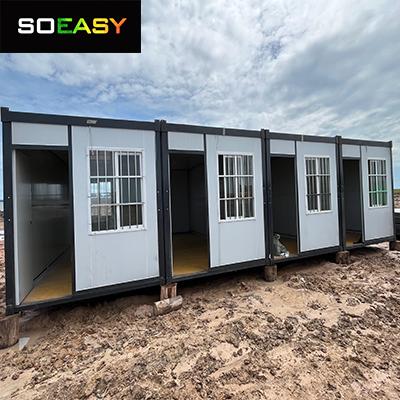
A folding container house is designed for projects where multiple accommodation units need to be delivered and installed efficiently. Its foldable structure helps reduce the shipping volume compared with transporting fully opened units.
SOEASY's standard folding container house has the following listed specifications:
These specifications make folding container houses particularly attractive for projects that require a large number of relatively standardized buildings.
Why choose a folding container house?
Efficient transportation: The folding design allows multiple units to be loaded into one shipping container, helping buyers reduce the number of shipments required for large projects.
Rapid installation: The simple unfolding process can reduce on-site assembly work. This is especially useful when a project needs accommodation buildings ready within a limited construction schedule.
Suitable for repeated layouts: When a project requires dozens or hundreds of similar dormitory units, standardized folding container houses make it easier to organize accommodation areas.
Practical for temporary facilities: These units can be used for construction site offices, worker accommodation, security rooms, and other temporary facilities, depending on the selected configuration.
For buyers planning large-scale accommodation projects, SOEASY folding container houses offer a practical option for projects where compact transportation and quick deployment are important considerations.
An expandable container house is designed to provide more indoor space after the structure is opened. During transportation, the building remains in a narrower configuration. Once delivered, the expandable sections are opened and secured to create a wider living area.
SOEASY's expandable container house category provides a representative configuration with the following dimensions:
Actual dimensions, interior layouts, and installation methods can vary between expandable container house models, so buyers should confirm the specifications of the selected unit before ordering.
Why choose an expandable container house?
More usable indoor space: The expanded structure provides a wider interior than the closed transportation configuration. This makes it easier to arrange bedrooms, living areas, and other functional spaces.
More complete living arrangements: Some models can include bedrooms, kitchens, bathrooms, doors, windows, and electrical systems, depending on the selected design.
Suitable for individual or family accommodation: When a project needs more than a basic sleeping room, an expandable unit can provide a more practical living environment.
Flexible interior design: Buyers can discuss room arrangements, doors, windows, and interior fittings according to the intended application and available product options.
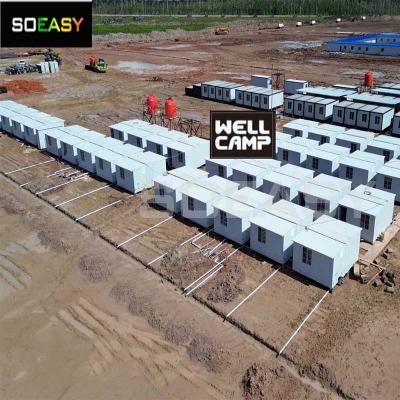
For projects where indoor space is a priority, SOEASY expandable container houses provide different configurations for accommodation and modular living applications.
For most buyers, the easiest way to compare these two building systems is to look at their transportation, installation, available space, and intended applications together.
| Comparison Factor | Folding Container House | Expandable Container House |
|---|---|---|
| Main design | Foldable structural design | Expandable opening design |
| Transportation configuration | Folded into a compact configuration | Closed into a narrower configuration |
| Representative dimensions | 2.5m × 5.8m × 2.6m | 5.8m × 6.3m × 2.5m when opened |
| 40HQ loading capacity | Up to 12 units | 2 units for the listed configuration |
| Installation reference | About 4 minutes with 4 workers | Depends on the model and installation method |
| Indoor space | Standard modular room layout | Wider space after expansion |
| Typical applications | Worker dormitories and temporary offices | Living units and larger accommodation spaces |
| Main purchasing priority | Transportation and deployment efficiency | Indoor space and living functions |
Important: The figures above are based on representative SOEASY product specifications, not universal specifications for every model. Actual loading quantities and installation times depend on the selected design, package dimensions, shipping conditions, and site requirements.
If transportation efficiency is the main concern, a folding container house generally has an advantage in SOEASY's listed standard configurations.
For example, the standard folding container house can load up to 12 units in one 40HQ container, while the listed expandable container house configuration can load two units in one 40HQ container.
This difference matters when a project needs a large number of buildings. Fewer shipments can help reduce freight costs, delivery coordination, and unloading arrangements.
However, shipping capacity should not be the only factor in the purchasing decision. Expandable container houses provide a larger usable area after opening, so buyers should also compare the cost per usable square meter rather than only the cost per transported unit.
When requesting a quotation, compare:
A project that needs many basic accommodation rooms may benefit more from folding units. A project that needs fewer but larger living spaces may find expandable units more suitable.
Folding container houses are a strong option when fast, repeated installation is required. SOEASY lists an installation reference of approximately four minutes for one standard folding container house with four workers.
Expandable container houses also have quick installation designs, but the actual process depends on the model. Some products use manual opening and assembly, while other configurations may require lifting equipment or additional installation steps.
For example, SOEASY's expandable product information includes models that can be installed through a manual multi-step process, while another listed expandable model specifies crane-assisted installation within five steps and approximately one hour.
Therefore, buyers should not assume that every expandable container house has the same installation time or equipment requirements.
Before confirming an order, ask the manufacturer for an installation video, a step-by-step guide, the required number of workers, and a list of tools or lifting equipment needed for the exact model.
For construction sites and mining camps, the right choice depends on how many workers need accommodation and what type of living space the project requires.
Folding container houses are suitable when:
Expandable container houses are suitable when:
For a large mining camp, these two systems do not necessarily need to compete. A project can use folding container houses for standard worker dormitories and expandable container houses for selected management accommodation or larger living spaces.
SOEASY also provides prefabricated mining camp accommodation solutions for projects that need a combination of worker housing and supporting facilities.
Before deciding between a folding and expandable container house, review the following project requirements. These details will help you avoid choosing a building that looks suitable in a product photo but does not work well at the actual site.
Providing these details to the manufacturer makes it easier to compare the two systems based on actual project requirements rather than general product descriptions.
SOEASY, a modular housing brand under Guangdong Wellcamp Steel Structure & Modular Housing Group, focuses on prefabricated building solutions for construction camps, mining camps, workforce accommodation, temporary facilities, and other modular housing applications.
Rather than offering only one type of container building, SOEASY provides different modular systems to meet different transportation, installation, and space requirements.
Its product range includes folding container houses, expandable container houses, flat pack container houses, prefab K houses, and other customized modular buildings.
For buyers, this means the project can be evaluated according to the required building functions instead of forcing every application into the same product design.
SOEASY can also support project planning with customized layouts, size options, interior configurations, material selection, and technical drawings. These details are particularly useful for contractors and project owners who need to coordinate multiple accommodation units.
If you are comparing different modular building options, you can also explore the SOEASY flat pack container house range as another option for projects that require modular transportation and connected building layouts.
Whether you need compact worker dormitories or larger expandable living spaces, the best solution starts with understanding your transportation conditions, accommodation capacity, and site requirements.
Contact SOEASY's modular housing team to discuss your project and compare suitable folding and expandable container house configurations.
What is the main difference between a folding container house and an expandable container house?
A folding container house uses a foldable structure to reduce transportation volume and simplify installation. An expandable container house opens into a wider building after delivery, providing more indoor space for living and accommodation.
Which is better for large construction camps?
Folding container houses are often more suitable for large construction camps that need many standardized dormitory units because their transportation configuration allows more units to be loaded into a shipping container. Expandable units are better suited to applications that require more indoor space per building.
How many folding container houses can fit in a 40HQ container?
SOEASY lists a loading capacity of up to 12 units in one 40HQ container for its standard folding container house measuring 2.5m × 5.8m × 2.6m. Actual loading quantities should be confirmed for the selected model and packaging configuration.
How many expandable container houses can fit in a 40HQ container?
SOEASY lists a loading capacity of two units in one 40HQ container for its representative expandable container house configuration. Other models may have different dimensions and loading capacities.
Which container house is faster to install?
SOEASY's standard folding container house has a listed installation reference of approximately four minutes with four workers. Expandable container house installation time varies by model, with some designs requiring manual assembly and others using lifting equipment.
Can an expandable container house include a kitchen and bathroom?
Yes. SOEASY's expandable container house category includes a representative design with two bedrooms, an opening kitchen, and one toilet. Other interior configurations and equipment options should be confirmed with the manufacturer.
Can folding container houses and expandable container houses be used together?
Yes. A project can combine folding container houses for standard worker accommodation with expandable container houses for larger living spaces or selected management units. The layout should be planned according to site conditions, utility connections, and the intended building functions.
Which option is more cost-effective?
Folding container houses may offer better transportation efficiency for large quantities of standardized units. Expandable container houses may provide better value when more indoor space and additional living functions are required. Buyers should compare total delivered cost and usable floor area before making a decision.
For all requests, you can contact us :


 IPv6 network supported
Scan to wechat: